Rockstar North on how it made GTA 6: the duo, stealth and cops
Restart.run exclusive: Rockstar North devs on handshakes in the open world, stealth, the criminal profile and police that track you by your trail.
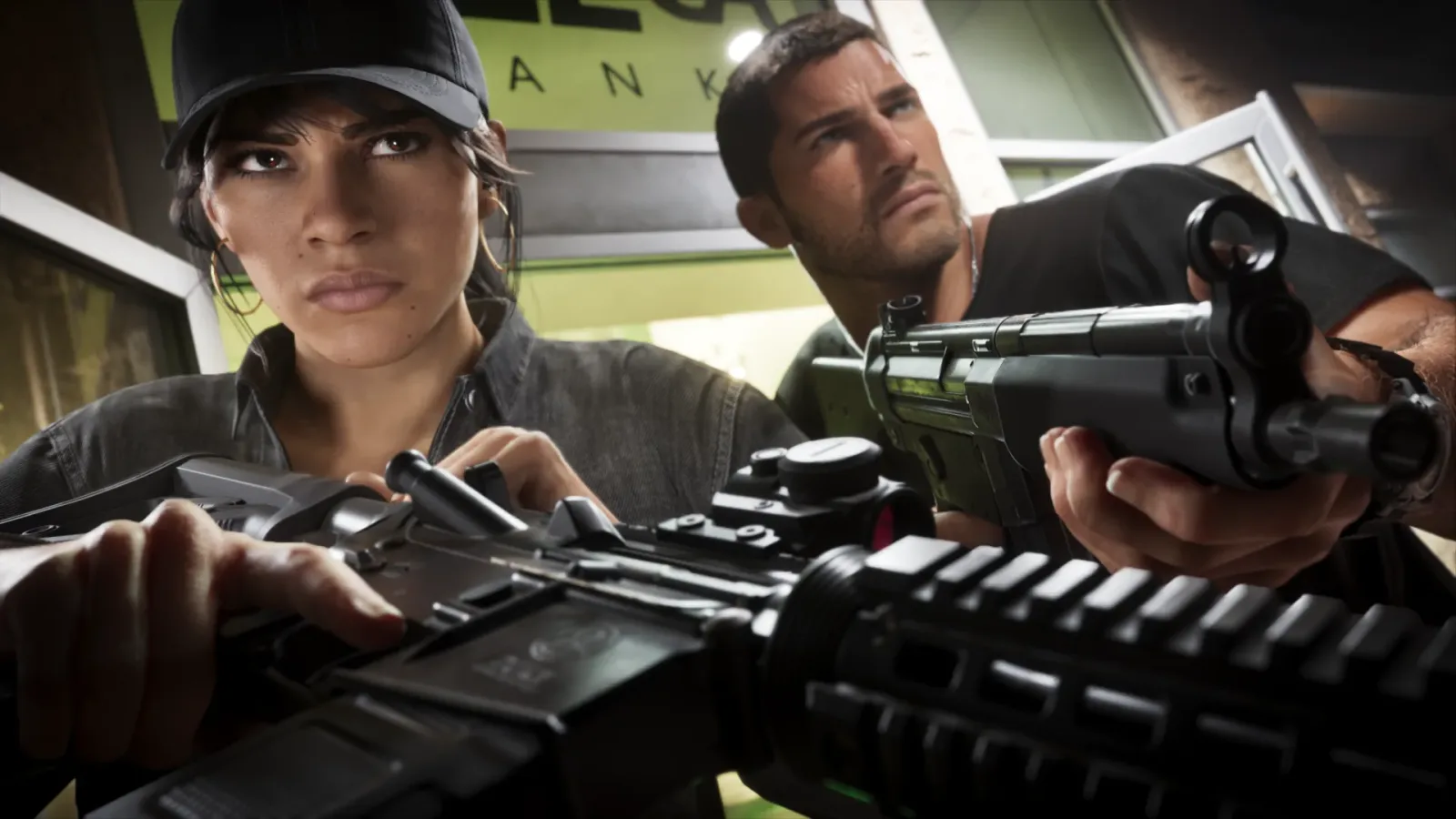
Five days after GTA 6 launched, the Rockstar North team answered questions from Restart.run — the interview came out on November 24, 2026. The people answering weren’t marketers but those in charge of missions, technology, art and physics: from the senior design director to the president of the studio. The conversation explains several things players are already discussing all over Leonida: why Jason and Lucia hold hands in the middle of the street, how non-lethal routes work, and why the police no longer know where you are.
Who answered the questions
- Luke Howard
- senior design director for missions and visualization
- David Hynd
- vice president of technology
- Ian Davis
- president of Rockstar
- Katie Pica
- design director for player systems and progression
- Paul MacPherson
- senior vice president of environment art
- Ben Lyons
- technical director for physics
- Rob Nelson
- head of development
Two instead of three
Howard explains the difference from GTA V bluntly: that was a story about three independent heroes with their own plans who sometimes came together on one mission. In GTA VI everything is built around two people with a shared goal, connected to each other and obliged to help each other. This premise drove a design requirement: wherever possible, a mission has to work both when playing as one character and when playing as the pair, while keeping the story logic in the spirit of Bonnie and Clyde.
The handshake that moved into the open world
The mechanic everyone noticed in the first hours was invented for one specific scene. According to Hynd, the gameplay and animation team got so carried away with the connection between the heroes that they raised the handshake to the level of the open world — now you can hold hands at any moment. Then came the small physical touches: Jason and Lucia don’t jump into the car at the same time but wait and glance at each other, hold the door, hug in a quiet moment. They separately worked out how often and where they look, what their faces do in different situations. Hynd’s most telling admission: these details became obvious precisely through their absence when you play as the pair in the open world.
The police search, they don’t know
The most practical part of the interview is about the wanted level. Hynd says outright: in GTA V and RDR2 the cops always knew the player’s exact location, while in GTA VI they genuinely search, relying on clues in the environment. The six-level system was balanced in three passes. First they aimed for competence: patrols and chases have to keep up with the player in any situation. Then they turned the difficulty dials — some behaviors switch off at low levels and switch on at high ones, the reaction time to a crime and the number of patrols change. And only then came years of playtests so it all wouldn’t fall apart.
Stealth, a shot to the knee and a rating without kills
Ian Davis describes the rework of enemy perception: an opponent only learns about you if they saw you, heard you or got information from others. You can deal with one guard without alerting the whole neighborhood, but noise and flashy actions also work against you. The damage model was tuned so a person can be taken out of a fight without killing them: a shot to the knee ends a brawl without a corpse. For a mission completed without kills, the game awards a Non-Lethal rating — according to Davis, it’s one of the most satisfying achievements. At the same time, classic shooting hasn’t gone anywhere: you can mix approaches.
The criminal profile and Focus
Katie Pica ties the scale from Professional to Irredeemable to how a particular playthrough is played. If you keep a professional, you won’t be able to go on a rampage — you have to choose, and stealth becomes genuinely worthwhile because you want to avoid the police, not shoot it out with them. She explains activities like golf, fishing and the shooting range with the same logic: they demand concentration and therefore restore Focus, and they also reward the player for stepping off the main story line.
Rob Nelson, head of development, answers the last question briefly: after so many years the feeling is surreal, the team is both happy and nervous because people’s reaction can’t be predicted. The full text of the interview is on Restart.run (November 24, 2026).


Comments